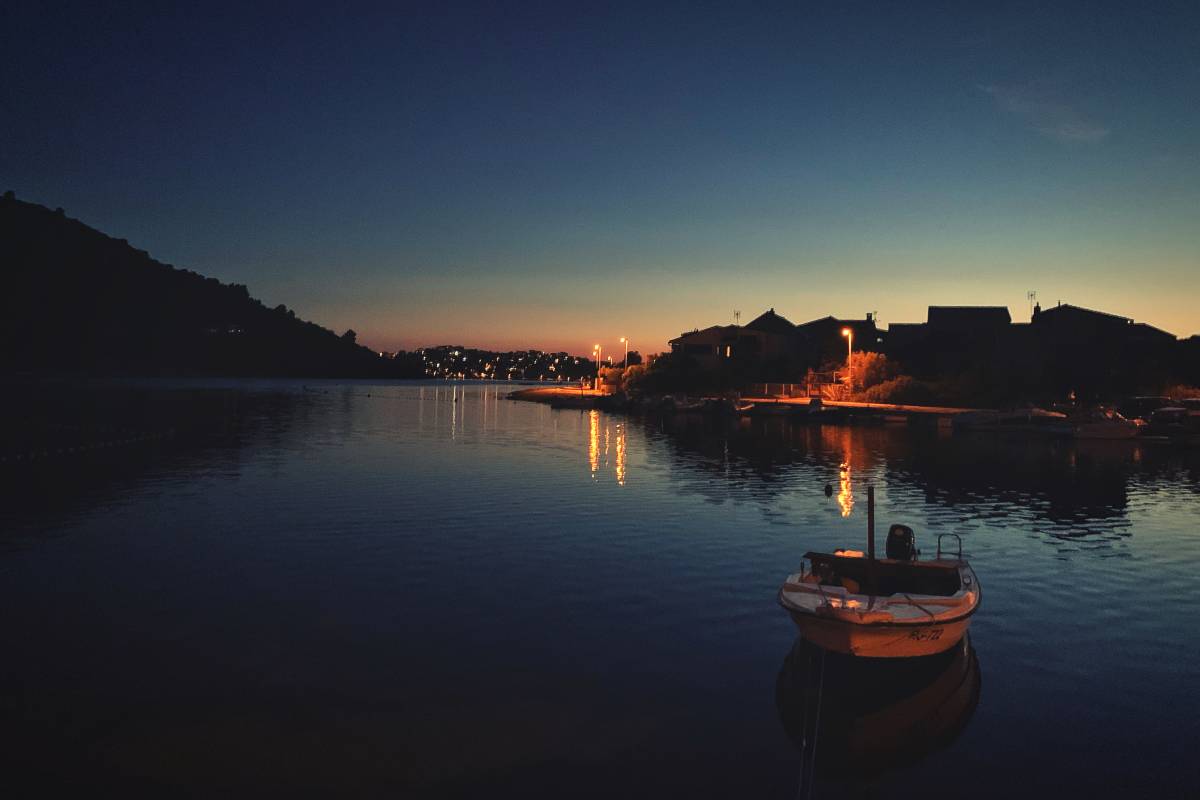
The sun is dipping below the horizon. The vibrant blues of the water are turning into an inky black void. You are miles from the marina, and a knot of anxiety tightens in your stomach.
Darkness on the water is not like darkness on land. There are no streetlights to guide you, no lane markers to keep you centred, and your depth perception—your brain’s ability to judge distance—completely vanishes. Suddenly, familiar waters feel alien, and the fear of striking a submerged log or misinterpreting another boat’s path becomes very real.
The Legal Stance
Can you drive a boat at night?
Yes, boats can legally travel at night in most navigable waters, provided they display the correct navigation lights (sidelights and stern/masthead lights) as mandated by international maritime laws (COLREGs). However, operators must maintain a safe speed, keep a designated lookout, and avoid using blinding docking lights while underway. Note that some private lakes or specific waterways may have local “sunrise to sunset” restrictions.
The “Dark Arts”: Why Night Boating is Different
When you drive a car at night, your headlights illuminate the road ahead. When you drive a boat at night, you are effectively driving into a black hole.
The biggest challenge isn’t technical; it’s psychological and physiological.
- Spatial Disorientation: Without a visible horizon, your inner ear and eyes can disagree on what is “level,” leading to vertigo. Whether you are navigating a local channel in the dark or assessing safety conditions for swimming in tropical waters, understanding how currents, weather, and visibility impact your environment is the first rule of survival.
- Background Scatter: Shore lights (street lamps, house lights) can blend with boat navigation lights, making it nearly impossible to distinguish a moving vessel from a stationary house.
- Loss of Depth Perception: Distances are notoriously difficult to judge at night. A light that looks five miles away might be a fishing boat 500 yards in front of you.
The Pro Tip: Don’t trust your eyes alone. You must learn to trust your chartplotter and your depth sounder.

Required Equipment: The Law vs. Common Sense
To travel legally at night, your vessel must meet the USCG (United States Coast Guard) or your local maritime authority’s requirements.
The Legal Minimums
If you are operating between sunset and sunrise, you must display:
- Red and Green Sidelights: Red indicates the Port (left) side; Green indicates the Starboard (right) side. These are visible to approaching vessels.
- All-Round White Light (or Stern/Masthead combination): A white light visible from 360 degrees (for smaller boats) or a combination of stern and masthead lights (for larger vessels).
The principle of ‘see and be seen’ isn’t exclusive to marine environments. Just as cyclists must strictly adhere to visibility protocols to reduce injury risk and stay safe on the road, boaters must treat their navigation lights as their primary line of defence against the void of the dark.
The “Smart Captain” Additions
Legal doesn’t always mean safe. Here is what we actually recommend carrying:
- A High-Lumen Spotlight: Only for momentary use to identify buoys or markers. Never leave this on.
- Thermal Camera or Night Vision: If budget allows, FLIR cameras turn night into day and reveal unlit obstacles like floating logs.
- PFDs (Life Jackets) with Strobes: If someone falls overboard at night, finding them without a light attached to their vest is nearly impossible.
Safety Note: If you find yourself uncomfortable with the risks of night navigation during a long-haul move, it is often safer to transport your vessel by road. Professional services like Interstate Boat Towing AU can handle the logistics of moving your boat between regions, ensuring it arrives safely without you having to navigate treacherous, unfamiliar waters after dark.
Understanding the Language of Lights
At night, other boats are just floating constellations. You must learn to read them to avoid collisions. This is based on the COLREGs (International Regulations for Preventing Collisions at Sea).
Scenario A: You see a Green Light and a White Light
- What it means: You are looking at the starboard (right) side of a vessel.
- Who has the right of way? You do. This is a “crossing situation,” and you are on their starboard side (the danger zone). They should yield to you. However, never assume they see you.
Scenario B: You see a Red Light and a White Light
- What it means: You are looking at the port (left) side of a vessel.
- Who has the right of way? They do. Think of the red light like a stop sign. You must slow down or alter course to pass behind them.
Scenario C: You see only a White Light
- What it means: You are likely overtaking a vessel from behind (seeing their stern light) OR looking at an anchored vessel.
- Action: Steer clear and pass with caution.
The Headlight Myth: Why You Can’t See Forward
This is the most common mistake new boaters make.
“Why don’t boats have headlights like cars?”
Boats do have “docking lights” (bright beams on the bow), but you should never run with them on. Here is why:
- Night Vision Destruction: It takes your eyes 20–30 minutes to adjust to the dark. Bright lights on your bow reflect off the water and white fibreglass, constricting your pupils and ruining your ability to see anything past the beam.
- Confusion: Other boaters may confuse your headlights for a shore light or a non-navigation light, causing dangerous misunderstandings.
The Rule: Only turn on your docking lights when you are approaching the dock and moving at idle speed.
5 Critical Safety Rules for Night Navigation
To dominate the dark, follow these operational rules used by professional captains.
1. Slow Down (The “over-driving” rule)
Never travel faster than your visibility allows. If you hit a submerged log at 30 knots in the dark, you might not survive the impact. Reduce your speed by at least 50% of your daytime pace.
2. Dim the Dash
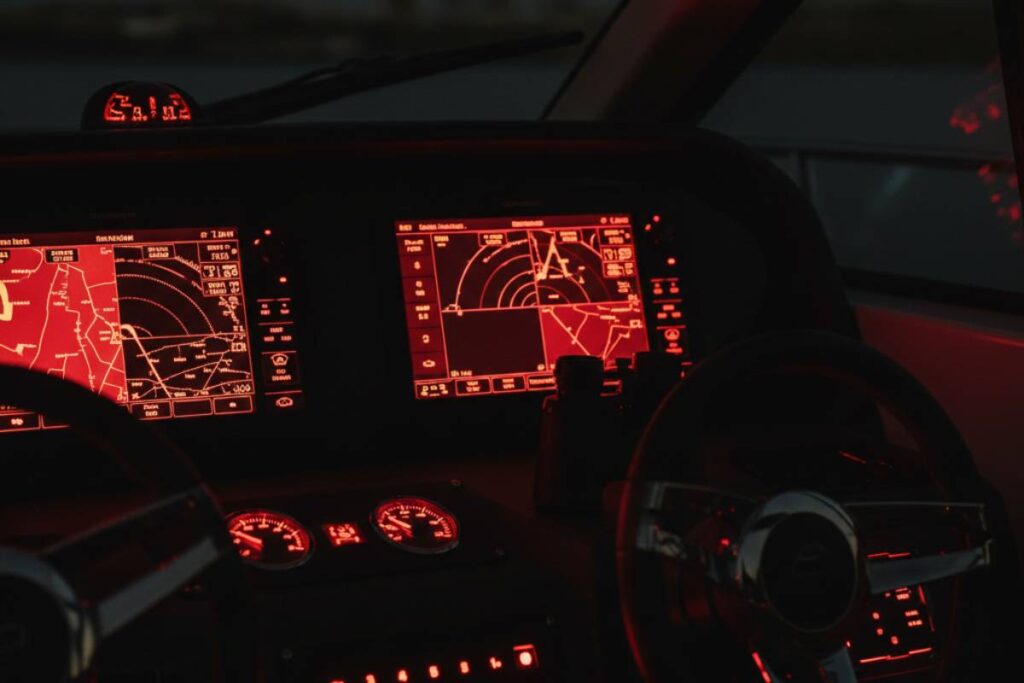
The glow from your GPS screen or gauges can be blinding.
- Turn your chartplotter to “Night Mode” (usually a red or black color scheme).
- Dim all dashboard gauges to the lowest visible setting.
3. The Designated Lookout
If you have passengers, use them. Assign one person to do nothing but scan the horizon. Two sets of eyes are infinitely better than one. Ask them to listen as well—often you will hear a wave break against an obstacle before you see it.
4. Trust Your Compass
It is easy to drive in circles at night. Pick a heading on your compass or GPS and stick to it. Do not rely on “feeling” where straight is.
5. Preserve Night Vision
If you need to check a map or find a gear bag, use a red light flashlight. Red light does not deplete the chemical rhodopsin in your eyes, which is responsible for night vision.
How to Dock in the Dark Without Crashing
Returning to the slip is the most stressful part of the journey. Depth perception is gone, and shadows hide the pilings.
- Preparation: Have your fenders and lines ready before you enter the marina.
- Lights On: Now is the time to turn on those docking lights.
- Communication: If you have passengers, have them shine a flashlight on the pilings, not into your eyes.
- The “Neutral” Trick: Use short bursts of gear. Put the engine in gear for a second to get momentum, then back to neutral. Glide in. Don’t power in.
Conclusion
Can boats travel at night? Absolutely. In fact, night boating offers a solitude and beauty that daytime crowds simply cannot match. The water is often calmer, the stars are brighter, and the experience is serene.
However, the margin for error is razor-thin.
Legality is the easy part; competence is the hard part. Ensure your lights work, slow your speed, and respect the sensory limitations of the human body. If you treat the darkness with respect, it will welcome you. If you ignore the risks, it can turn dangerous in seconds.
We want to hear from you: Have you ever navigated in pitch black? What is the one piece of gear you wouldn’t leave the dock without?